Hamiltonian-estimation, coherent-control, and interaction-characterization workflows for semiconductor spin-qubit experiments.
This project summarizes coherent-control, readout, and interaction-characterization work in semiconductor spin-qubit platforms, including GaAs and isotopically enriched silicon/silicon-germanium quantum-dot systems. The experimental workflow includes cryogenic device operation, automated measurements, pulse calibration, Hamiltonian estimation, randomized benchmarking, and gate-set tomography.
In GaAs quantum-dot arrays, I played a central role in Hamiltonian-estimation and readout-optimization workflows. The experiments combined energy-selective tunneling readout, Bayesian parameter estimation, and active control to stabilize qubit frequencies, reduce drift, and improve high-visibility qubit operation.
For two-qubit operation, I co-led the experimental workflow for characterizing capacitive coupling between singlet-triplet qubits beyond the bilinear regime. I executed key experiments, implemented the dual Hamiltonian parameter-estimation workflow, and performed primary analysis for two-qubit coupling characterization.
In Si/SiGe devices, the work studied singlet-triplet qubit coherence and coupling to nearby many-electron spin states. These measurements connect qubit control, charge configuration, and environmental degrees of freedom in a platform relevant to scalable semiconductor quantum processors.
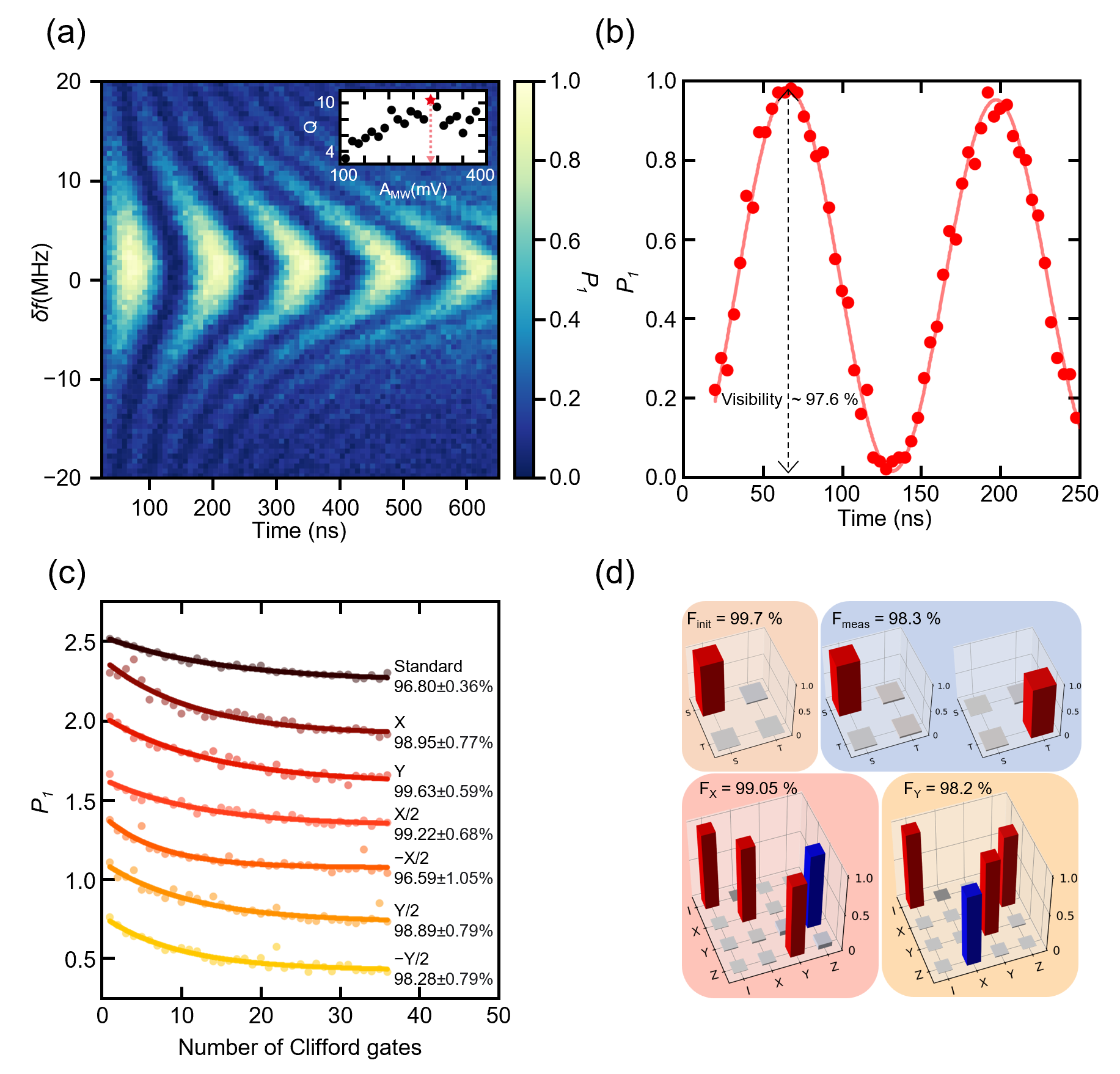
Figure 1 (a) Rabi oscillation. Inset: Oscillation quality factor as a function of rf amplitude. The red symbol marks the condition for the maximum quality factor. (b) Representative Rabi oscillation with visibility higher than 97%. The oscillation is fit to the sinusoidal function with the Gaussian envelope. (c) Singlet return probability as a function of the number of random Clifford gates obtained from a single qubit standard and interleaved randomized benchmarking. Traces are offset by 0.3 for clarity. (d) Density matrices (top row) and Pauli transfer matrices (bottom row) evaluated by gate set tomography.
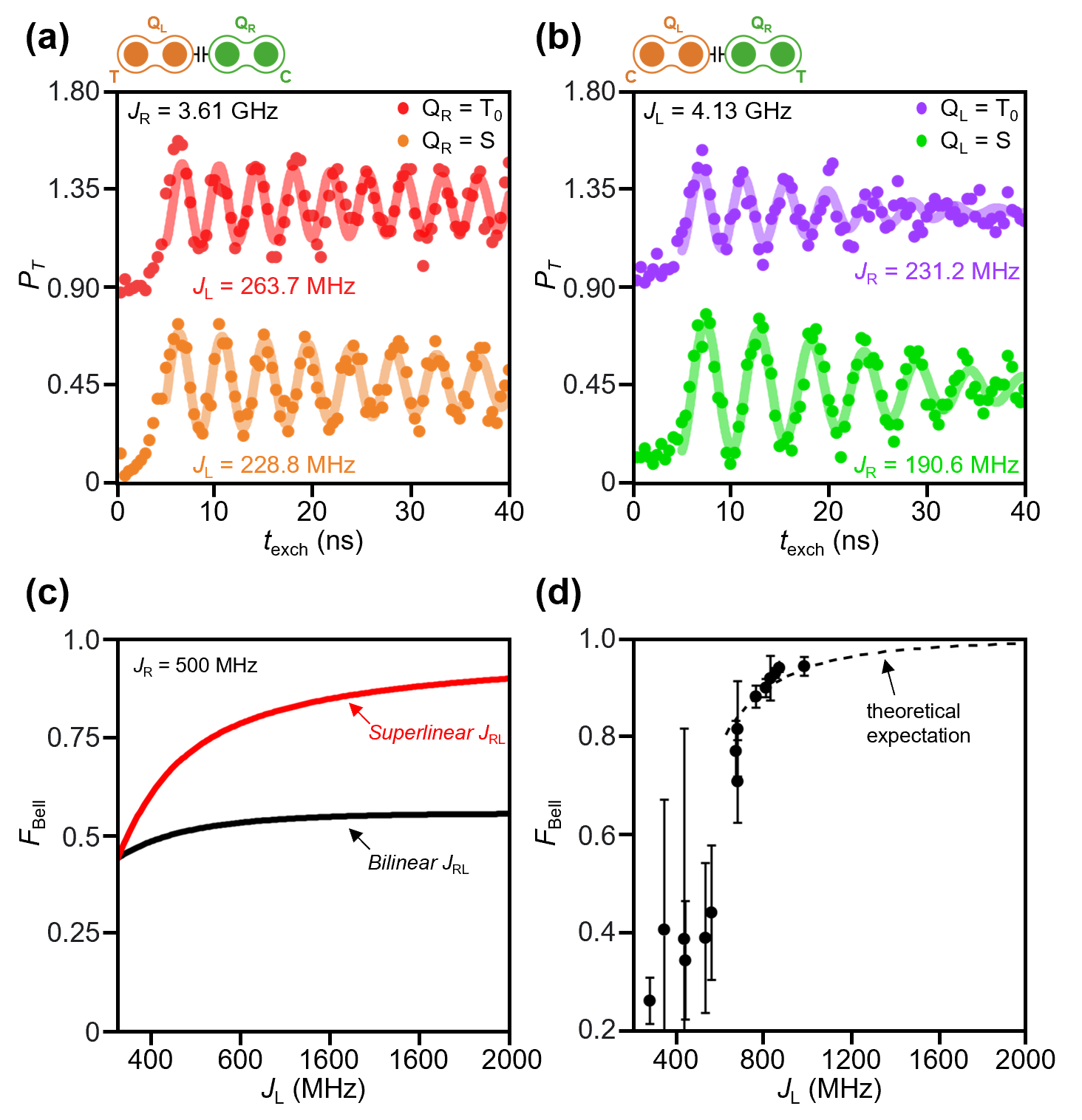
Figure 2 (a,b) The exchange oscillations of QL (QR) depending on the state of the other qubit as control. The lower and upper traces are measured when the state of QT is singlet and triplet, respectively. (c) The simulated maximum attainable Bell state fidelity as a function of JL for bilinear (black) and superlinear (red) JRL. The fidelity is estimated at JR = 500 MHz. (d) The estimated maximum attainable Bell state fidelity from the experimental values. The fidelity shows an increasing tendency with a maximum value of ~0.95. The error bars are estimated from the uncertainty of JRL and Techo of each qubit.
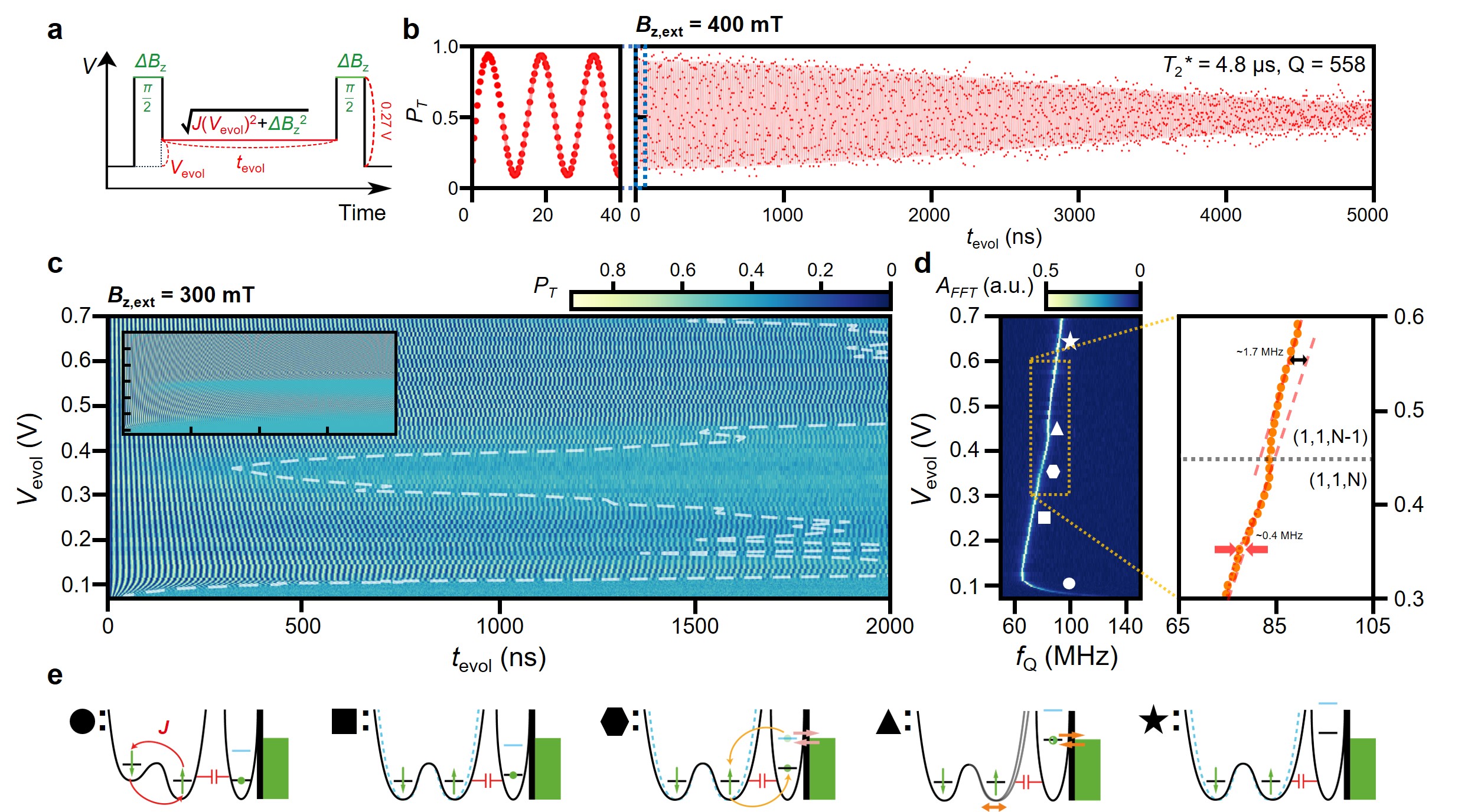
Figure 3 (a) Schematic diagram of pulse sequence for a Ramsey oscillation, the z-axis manipulation on Bloch sphere during the free evolution time tevol and the pulse amplitude Vevol. π/2 pulse was applied with Vevol = 0.27 V and properly calibrated pulse duration time. (b) The representative Ramsey oscillation with the probability of triplet state PT in Bz,ext = 400 mT and Vevol = 770 mV, which shows high coherence time T2* and quality factor Q* values. The left and the right figures were 10000 and 100 times averaged, respectively. (c) Ramsey oscillations as a function of tevol and Vevol. The white dashed line indicates the contour line of T2* extracted from each Ramsey oscillation line of Vevol. The inset shows the reproduced Ramsey oscillation results through numerical simulation. (d) Line-to-line FFT result of (c). The expected transition line of the right dot is indicated as a dotted line on the right figure. Two dashed orange lines show the linearly fitted fQ with Vevol before and after the frequency shift of ΔfQ ~ 1.7 MHz during the charge transition of QDR. A small bump with maximum ΔfQ ~ 0.4 MHz, indicated by the red dotted line, is the footprint of the enhanced spin-dependent charge number fluctuation led by fast tunneling between QDR and the electron reservoir on the right side of QDR. (e) Schematic illustration for each marker in (d) that depicts the energy levels of each dot, capacitive coupling between ST0 qubit and QDR, and the tunneling between QDR and the electron reservoir.
Quantum Dot Spin Qubit Experiments Jan. 2022 – Feb. 2023
⌜Performed high-fidelity single- and two-qubit operations in both GaAs and ²⁸Si/SiGe quantum dot systems. Optimized single-qubit gate fidelity to >99.6% using real-time Bayesian Hamiltonian estimation. Discovered and characterized a strong, superlinear two-qubit capacitive coupling (>190 MHz) beyond the bilinear regime. Analyzed qubit coherence as a function of system parameters and demonstrated coherent coupling to ancillary dot spin states.⌟
A central challenge in quantum computing is the high-fidelity control and readout of qubits in the presence of environmental noise.
My research has focused on developing and implementing advanced techniques to address this challenge in semiconductor spin qubits.
These projects were made possible by a comprehensive experimental toolkit for operating and characterizing quantum devices at cryogenic temperatures.
Measurements were automated using the Labber software environment, with quantum dots defined by low-noise DC sources (SRS SIM928) and qubit states manipulated by an AWG and a Zurich Instruments UHFLI.
My hands-on experience includes IQ mixer calibration and programming a Quantum Machines OPX controller using QUA for real-time feedback.
In a GaAs quantum dot array, I implemented a Hamiltonian estimation protocol based on energy-selective tunneling to perform real-time Bayesian inference of system parameters.
By actively feeding back this information, we corrected for quasi-static noise and demonstrated a single-qubit gate fidelity of 99.6%, confirmed via Randomized Benchmarking (RB) and Gate-Set Tomography (GST).
This work was published in Physical Review Letters.
Scaling up quantum processors requires robust inter-qubit coupling. While capacitive coupling between singlet-triplet qubits is typically weak and bilinear, I experimentally demonstrated a strong two-qubit capacitive interaction (>190 MHz) in a GaAs quadruple-dot array.
This interaction exhibited a state-conditional frequency shift that was distinctly beyond the bilinear regime, consistent with recent theoretical predictions, and was published in npj Quantum Information.
To further explore qubit performance in an isotopically purified environment, I characterized singlet-triplet qubits in a ²⁸Si/SiGe double quantum dot.
We achieved fast qubit oscillations (~100 MHz) with a quality factor over 580 and found evidence of coherent coupling between the qubit and the spin states of a nearby quantum dot,
demonstrating that the spin-electric coupling in this system may enable a charge-based two-qubit gate, as detailed in npj Quantum Information.